
Kimberly Grey is the author of an essay collection, A Mother Is an Intellectual Thing, and two collections of poetry, Systems for the Future of Feeling and The Opposite of Light, winner of the 2015 Lexi Rudnitsky First Book Prize in Poetry. A former Wallace Stegner Fellow at Stanford University, she earned her PhD at the University of Cincinnati and is currently Assistant Professor of Creative Writing in the graduate program at the University of North Texas.
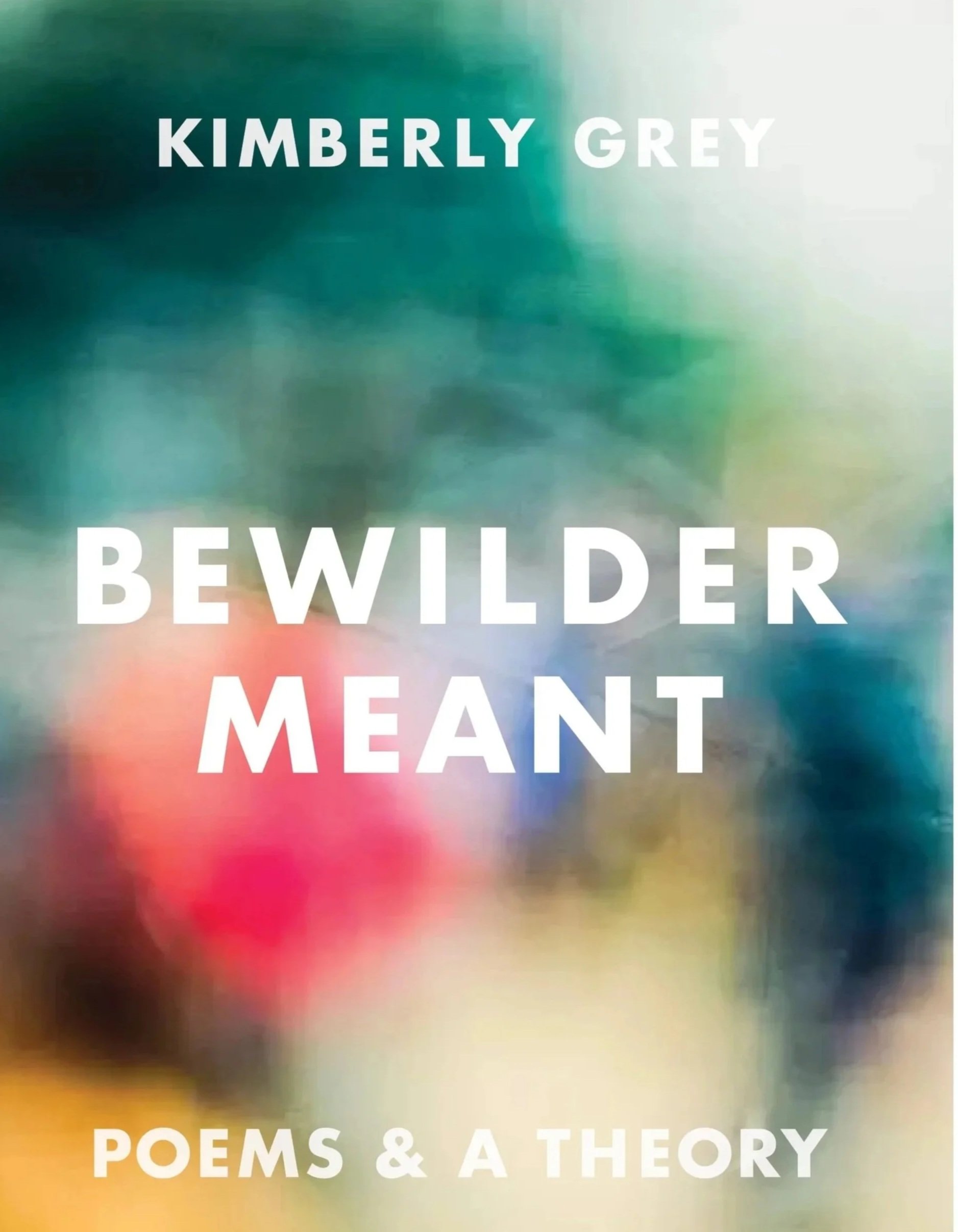
Bewilder Meant
Poems and A Theory
Kimberly Grey
Bewilder Meant is a hybrid work of critical-poetic essay and poetry that explores memory’s instability, language’s limits, and the persistence of desire. In conversation with Roland Barthes’ Camera Lucida, the book relocates the force of the punctum from the photographic image to poetic language itself, asking whether words can wound, preserve, and transform experience in ways that images cannot. Love and loss appear less as narrative than as residue: a beach, a kitchen floor, a photograph hidden in a book, the movement of light through the Pantheon, a spider's gesture, the smell of soup, the flutter of butterflies. Together, these poems develop a phenomenology of attention in which perception continually remakes the world it observes. Refusing resolution, Bewilder Meant dwells in fracture and trace, treating art as a site of astonishment.
“Mary and Percy Shelley and William James wrote of “vastations” – those sudden, devastating epiphanies in which you are overcome by alienation, abandonment, or the indifference of the cosmos. In Bewilder Meant, Kimberly Grey writes out of and into this simultaneously embodied and metaphysical void. The poet emerges herself as an “aftermath” – something, or someone, mysteriously and violently abandoned, erased by a mother and also by a lover. This vertiginous, arresting book sounds out this predicament. Grey sustains a remarkable high wire act – conducting a nuanced and ferocious inquiry without a net. If melancholia – unlike mourning – is interminable, Grey holds to it: her anatomy of melancholy offers not a stay against confusion but an insistent staying with, rotating through – scenes, propositions, quotations, surcharged words (not least “mother”), sense memories, numinous and ruinous terrifying phrases. Bewilder Meant is simultaneously a philosophical meditation, aesthetic treatise, and erotic inquiry. With tutelary spirits Roland Barthes and Paul Celan, Grey maps a lyrical-theoretical horizon. Here we have impossible elegy – a speaking not to the dead but to those to whom one is, apparently, dead. Here we also have extraordinary vivification – of the presence of the past, a beloved body, ruptures within the mind, places and rooms and “a square grave of love. Grey undertakes a simultaneously desperate and patient poetics, an inquiry into making, looking, feeling; she sounds out, feels out, the negative space of what can be brought into language, the underside and undersong of loss. Yet Grey’s poetry gives us – unlike the photograph, a memento mori – a “memento desideria: a reminder of desire.” Bewilder Meant vibrates throughout with a sensuous shimmer and virtuosic thinking.”—Maureen N. McLane
Paperback / $19.00 (Can. $27.00) / ISBN 978-0-89255-657-1 / 128 pages / Poetry (and Theory)